

The Mystery of Convergent Hallucinations
Software engineers and AI practitioners frequently observe a bizarre phenomenon: when testing an intricate mathematical edge case, a nuanced SQL optimization, or a multi-variable logic riddle, completely independent foundation models from OpenAI, Google, and Anthropic will often output the exact same flawed rationale.
If these frontier models are trained on billions of diverse parameters with distinct architectural weights and alignment recipes, why do they converge on identical blunders? The answer lies in the structural mechanics of modern generative AI.

1. The Common Crawl Monoculture & Synthetic Data Contamination
Despite proprietary filtering, the vast majority of frontier LLMs drink from the same primary well: Common Crawl, Wikipedia, GitHub, arXiv, and Reddit dumps. When misconceptions, flawed Stack Overflow code snippets, or fallacious logic arguments exist widely on the public web, all foundation models internalize those statistical co-occurrences as truth.
Furthermore, as synthetic data generated by previous generation LLMs floods the web, models are increasingly ingesting the outputs of their competitors, creating a recursive "model collapse" loop where systemic errors become deeply reinforced.
2. The Autoregressive Trap: No Backtracking Allowed
Human beings reason iteratively: we formulate a hypothesis, begin calculating, notice a contradiction midway through, scratch it out, and restart. Standard autoregressive transformers cannot do this.
- Greedy Token Generation: Transformers predict outputs strictly token-by-token from left to right. Once a model commits to a premature probabilistic path in early reasoning steps, it is mathematically bound to rationalize that initial error in subsequent tokens.
- Attention Drift over Long Horizons: In multi-turn enterprise agentic workflows, context windows suffer from self-attention dilution. The model loses focus on core constraints, hallucinating intermediate steps to bridge logical chasms.
- Confidence Calibration Gap: Neural networks do not experience doubt. An LLM predicts incorrect tokens with the exact same fluent, authoritative tone as verified mathematical theorems.
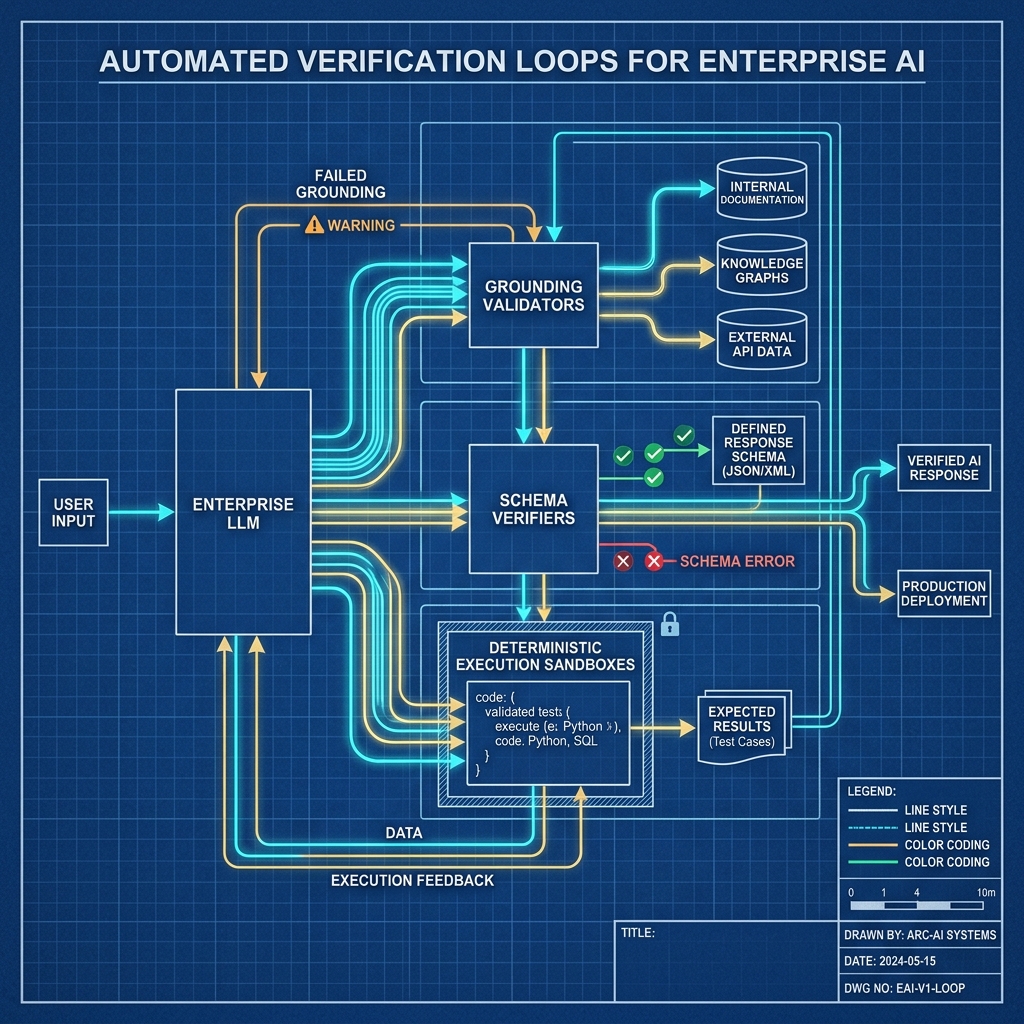
3. The Solution: Deterministic Sandboxing & Automated Verification
Enterprise applications cannot afford statistical guesswork in financial reporting, clinical diagnosis, or mission-critical code deployments. Relying on "prompt engineering" to fix hallucinations is fundamentally flawed.
The industry standard is shifting toward deterministic verification loops:
- Code Execution Sandboxes: Rather than allowing an LLM to calculate values conversationally, the model must write Python or SQL code that executes in an isolated environment, returning real runtime output.
- External Schema Validators: Enforcing strict Pydantic or JSON schema validation gates that immediately reject non-conforming responses before downstream consumption.
- Continuous Pipeline Auditing: Utilizing automated schema and data quality scanners-such as Fraoula Data Auditor-to detect anomalies, pipeline drift, and corrupted training data before they degrade production pipelines.
The Future of Reliable AI
Scaling raw parameter count will not eliminate reasoning loops. Real enterprise autonomy requires pairing stochastic neural models with deterministic guardrails. By treating LLM outputs as untrusted suggestions subject to rigorous runtime testing, modern engineering teams can build resilient, hallucination-free systems.